Clear the Deck: The Pre-Christmas Freezer Audit That Saves Money and Space
Somewhere at the back of your freezer, behind the peas and the tub of something labelled in biro, sits a chicken joint you froze in a hurry back in March. That is not a scandal. It is simply how freezers behave: they turn into a holding pen for good intentions.
Then December arrives, you order a decent bird from the butcher, and discover there is nowhere to put it. Christmas 2026 is close enough now to sort this out calmly rather than in a panic on the twenty-third.
The good news: a proper audit takes an afternoon, costs nothing, and usually pays for itself twice - once in the food you rescue, and again in the space you free up for what you actually want to eat.
Begin with an inventory, not a guess
Empty the whole thing onto the kitchen table. Yes, all of it. Work in batches if the freezer is a chest model, but don't skip the back corners - that is where the archaeology lives. As each item comes out, write it on a sheet of paper or in the notes app on your phone: what it is, roughly how much, and the date you froze it.
Nine times out of ten you will find three things: a stash of bread ends, a bag of something you meant to use for stock, and a joint that was bought for an occasion nobody remembers.
The three-question test
Everything that comes out gets asked the same three questions.
Is it labelled? If you cannot tell what it is, it goes. An unidentified bag of brown frozen matter is not a dinner; it is a gamble.
Is it still good? Your freezer is not a museum. As a rough guide, raw poultry and mince are best used within three to four months for flavour and texture, while a solid roasting joint will happily sit for six to nine months if it was wrapped properly. Anything that looks dry, pale or freezer-burnt gets cut away or binned.
Will we genuinely eat it? Be honest. If nobody in the house likes that particular thing, keeping it until 2027 will not change matters.
Turn the clear-out into two weeks of very good dinners
This is the satisfying bit. Instead of throwing away the marginal items, build a menu around them. The bag of cooked beef from a Sunday roast becomes a pie. Those stray sausages become a traybake with onions and potatoes. The last of the summer fruit goes into a crumble on a wet Tuesday.
Two weeks of eating down the freezer has an added benefit: your food bill drops noticeably in the run-up to Christmas, which is exactly when the bank account could use a breather. We hear this from customers every November, and it works.
Give it a proper wash while it is empty
An empty freezer is an opportunity you get about once a year. Switch it off, let it defrost fully, and wipe the inside with a solution of bicarbonate of soda and warm water - roughly two tablespoons to a litre. It lifts smells without leaving a chemical tang.
Pay attention to the door seals, which collect crumbs and the occasional sticky dribble, and to the drainage channel at the back of a fridge-freezer. A cotton bud or a bit of kitchen roll twisted into a point does the job. Dry everything thoroughly before switching back on; moisture left behind just turns into ice.
Repack with purpose, not by shove
Group by type rather than by date - a shelf or drawer for meat, one for bread and pastry, one for fruit and veg, one for cooked leftovers. Freeze meat in portions you will actually cook. A four-portion bag of stewing steak is useful; a frozen brick of eight chops is not.
Freeze things flat where you can. Bags of mince and stewing cuts laid out like books on a shelf stack far better than lumpy parcels, and they thaw faster too. Label everything with contents and date - a strip of masking tape and a permanent marker is still the best freezer technology ever invented.
A butcher's view on getting the bird sorted early
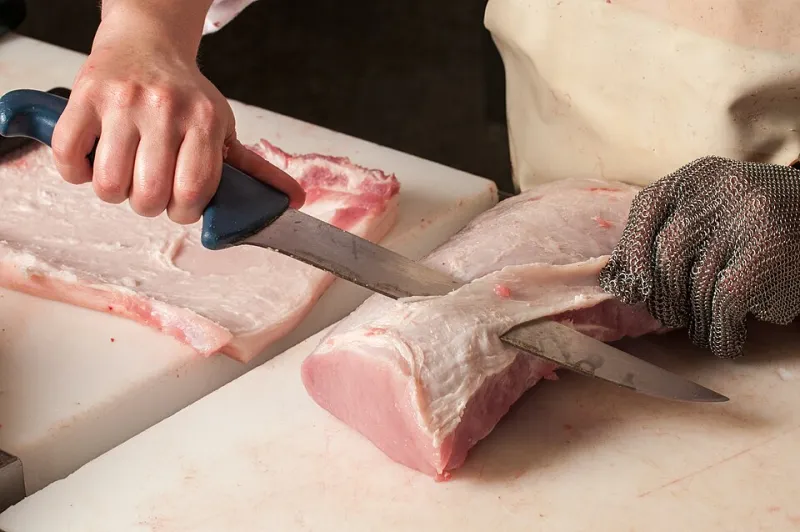
Here is the part that matters most for December. Supermarket freezers are stocked to a forecast, and the forecast is not always generous. Traditional butchers, by contrast, work to orders. If you want a particular size of turkey, a rib of beef, or a goose for the big day, reserve it now and agree a collection date. You will get the weight you asked for rather than whatever is left on the shelf.
As a rough rule, allow around 500g per person for a bone-in bird if you want leftovers - which, let us be frank, is the whole point. Tell your butcher how many are coming and they will steer you straight.
Freezing and thawing, done safely
If you buy fresh meat ahead of time, freeze it on the day you get it home. Wrap it well, squeeze out the air, and get it into the coldest part of the freezer quickly. Never refreeze meat that has already been thawed.
For Christmas, move the bird from freezer to fridge with plenty of time to spare. A large turkey can take two to three days to thaw completely in a fridge set at around 4C. Put it on a tray on the bottom shelf so nothing drips, and check the deepest part of the thigh with a skewer - the juices should run clear, not icy.
Do the work now, on an ordinary November afternoon, and Christmas Day becomes what it should be: a long, unhurried meal with people you like, and a freezer that is quietly doing its job in the background.