Beyond the Green Tick: Reading Beef Labels With a Butcher Beside You
Beef labels have become a crowded place. A pack can carry a green tick, a breed name, a flag, a farming claim and a cooking suggestion, all before you get to the price. None of that is useless, but none of it tells the whole story. The useful question is not which label sounds best. It is which label tells you something you can act on. That is where a butcher with a sharp knife and a straight answer earns their keep.
What grass-fed is really saying
Grass-fed sounds straightforward, but in the UK it is not a single legally defined term in the way organic is. It generally signals that cattle had grass in their diet, yet it does not automatically say how much, for how long, or what happened in winter. An animal may have grazed for part of the year and been fed silage or other forage later. That can still be a good system, but the label alone does not spell it out.
Grass-finished is more common in American beef marketing and is beginning to appear here. It points to the final stage of rearing, when cattle are finished on grass or forage rather than grain. The useful follow-up is simple: finished on grass for how long, and was the animal outdoors at the time? A butcher who knows the farm can usually answer.
Pasture-for-Life is different again. It is a certification with published standards, not just a phrase on a pack. It means cattle have been fed a diet of grass and forage, with no grain, and have had access to pasture. That is a meaningful claim because it is independently checked. It is not the same as every grass-fed label, and it is not the only route to good beef. It is simply one claim with more definition behind it.
The words that carry weight, and the ones that need a question
Native breed is about genetics, not feed. A Hereford, Aberdeen Angus, Shorthorn or Belted Galloway may be grass-fed or not. The breed can influence flavour, fat cover and size, but it does not guarantee a particular diet or welfare standard. It is useful information, not a complete story.
Red Tractor covers traceability, food safety and baseline welfare. It is not a grass-fed claim. Organic has legal standards, including rules on feed and outdoor access, but it is not identical to pasture-for-life. RSPCA Assured focuses on welfare. Each label answers a different question. A pack can carry several of them and still leave you unsure about the one thing you care about most: how the animal was actually raised.
That is not a reason to distrust labels. It is a reason to read them as shorthand. Shorthand is only useful if you know what it shortens.
What the packet cannot tell you
A packet can tell you country of origin, weight, cut and cooking advice. It can tell you that a piece was dry-aged, although the length of ageing may be buried in small print. It cannot easily tell you the farm, the breed, the age at slaughter, the hanging time or the trim. Those details matter because they change what happens in the pan.
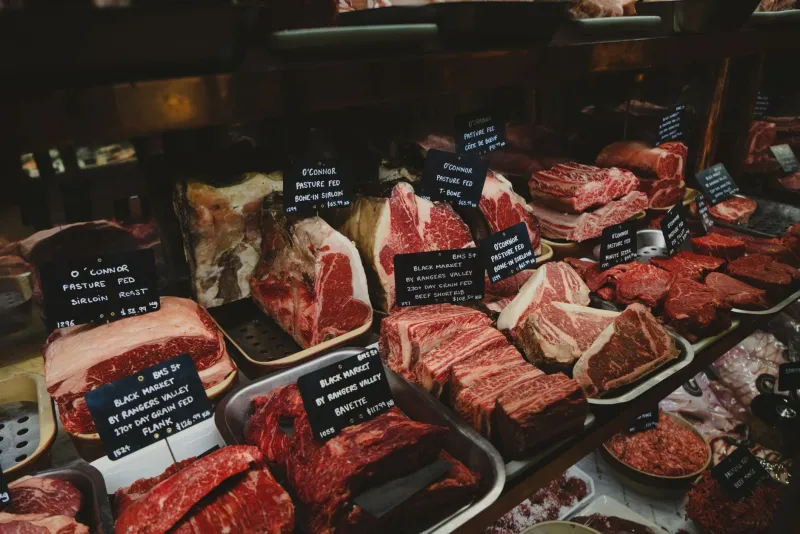
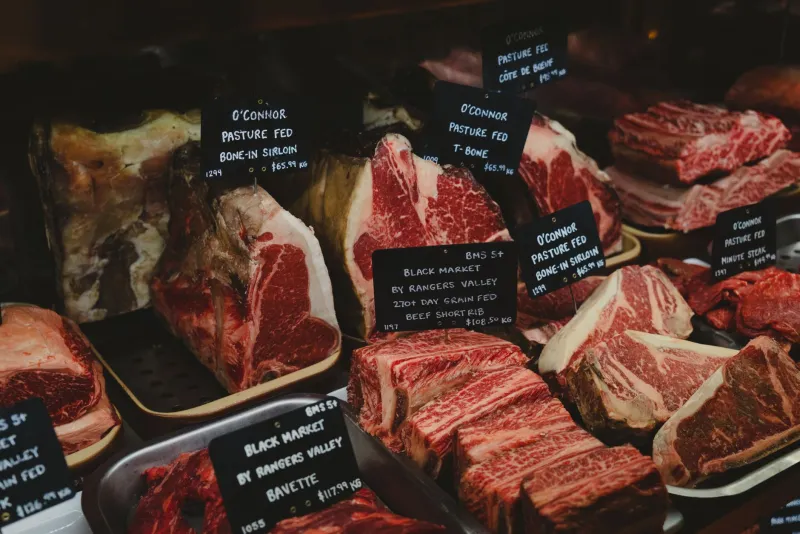
At a butcher's counter you can compare two pieces side by side. You can ask which farm the beef came from and how long the shop has worked with them. You can ask whether the grass-fed claim applies all year or only in summer. You can ask what the animal was finished on and how long it was hung. You can ask for a thicker chop, a leaner trim or a piece with more fat cover for roasting. None of that is possible through a packet.
A short script for the counter
You do not need to arrive with a list of technical questions. A few plain ones will do.
- Which farm did this come from, and what does grass-fed mean on this particular beef?
- Was it grass-finished, and for how long?
- What breed is it, and roughly how old was the animal?
- How long has it been hung, and is it dry-aged?
- How would you cook this cut, and what would you choose for a Sunday roast?
The answers will not always be neat. Some butchers will know the farm name without hesitation. Others will know the breed and the hanging time but need to check the feed. That is fine. A good counter conversation is not a test. It is a way of getting closer to the truth than a crowded label allows.
How this changes what you buy
Grass-fed beef often has a stronger, more mineral flavour and a leaner make-up than grain-finished beef. The fat can be more yellow, which is a sign of grass in the diet rather than a fault. It pays to cook it a little more gently, especially with lean cuts, and not to assume that more time in the pan equals more flavour. Native breeds can bring their own character: more fat cover, deeper flavour, different cooking qualities. A butcher can point you towards the right cut for the job.
At John Stewart Butchers, the aim is not to replace labels with a sales pitch. It is to put the missing detail back on the counter. Ask about the farm. Ask about the finish. Ask what the label leaves out. A good butcher will not mind. They will usually give you a straighter answer than any packet can.