Wings, Bones and All: A Butcher's Case for Buying Chicken Whole
Walk into most supermarkets and the chicken aisle tells a very narrow story: breasts, breasts and more breasts. They are convenient, no doubt. But they are also the most expensive way to buy chicken, and they leave behind the parts that carry the most flavour. At John Stewart Butchers, we would rather hand you a whole bird and show you what to do with it. A good chicken is not a single meal. It is a Sunday roast, a midweek traybake, a pot of stock and a jar of schmaltz, all from one purchase.
Why buy the whole bird?
Value is the obvious answer. Per kilo, a whole chicken usually costs less than jointed pieces, and far less than skinless breast fillets. But the better argument is flavour. Bones, skin and darker meat are where the character is. A chicken cooked on the bone tastes more like chicken. The carcass, which too often goes in the bin, makes stock that is better than anything from a cube. And the fat rendered from the skin will roast potatoes in a way that olive oil only dreams about.
There is a provenance point too. When you buy whole from a butcher, you can ask where it came from, how it was reared and whether it was hung or prepared on site. That conversation is harder to have with a plastic tray.
A quick word on choosing chicken
Look for a bird with intact skin, no bruising and a clean, mild smell. The joints should feel flexible rather than stiff. If you are buying free-range or higher-welfare chicken, the meat may be a little firmer and the legs slightly longer, which is no bad thing. Ask your butcher whether the bird is fresh or previously frozen, and whether it has been dry-plucked or wet-processed. A proper dry pluck gives you better skin for roasting.
At the counter, it is perfectly reasonable to ask for the chicken to be spatchcocked or jointed. Most butchers will do it while you wait, and it saves you a job at home. But doing it yourself is not difficult, and it gives you a better feel for the bird.
The five-minute jointing map
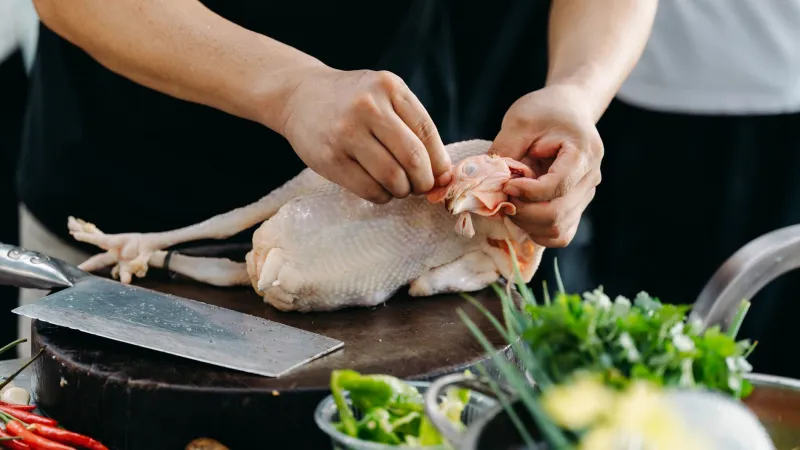
Place the chicken breast-side up on a board. Pull a leg away from the body and cut through the skin between leg and breast. Bend the leg back until the hip joint pops, then cut through the joint to remove the whole leg. Repeat on the other side. You now have two legs, which you can leave whole or split into thigh and drumstick.
Next, find the wishbone at the top of the breast and remove it if you like. Run your knife down either side of the breastbone and ease the breasts away from the carcass, keeping the skin on. Cut through the wing joints to remove the wings. What is left is the carcass, plus perhaps the wing tips and back. Do not throw them away.
Spatchcock: the weeknight roast
If you want one technique to master, make it spatchcocking. Ask your butcher to remove the backbone, or do it yourself with poultry shears. Turn the bird skin-side up, press down on the breastbone until it lies flat, and roast it at 200C fan for around 35 to 45 minutes, depending on size. The legs cook faster, the breast stays juicy, and the skin crisps beautifully. Rub it with softened butter, lemon zest and thyme, or keep it simple with salt and pepper.
A spatchcocked chicken is also excellent on a bed of sliced leeks, potatoes and bay leaves. The juices drip down and do the seasoning for you. This is the sort of cooking that makes a whole bird feel easy rather than ceremonial.
Carcass, skin and fat: the second act
Once the meat is off the bone, the carcass goes into a pot. Break it up a little, add cold water to cover, and bring it slowly to a bare simmer. Skim any foam, then add onion, carrot, celery, a bay leaf and a few peppercorns. Let it tick away for two to three hours. Do not boil it hard, or the stock will turn cloudy and taste muddy. Strain, cool and chill. The fat that sets on top can be lifted off and used for frying.
For schmaltz, take the skin and any visible fat, chop it roughly, and put it in a heavy pan with a splash of water. Cook gently until the water evaporates and the skin turns golden and crisp. Strain the fat into a jar and keep it in the fridge. The crispy bits are a cook's treat; scatter them over potatoes or salad.
Three ways to put it all to work
First, roast potatoes in chicken fat with rosemary and whole garlic cloves. Second, use the stock as the base for a leek and mustard risotto, finishing with a little grated cheese. Third, take the leftover roast chicken and fold it through a simple pie filling with mushrooms, thyme and a splash of cream.
None of this is fussy. It is just the old-fashioned approach: buy well, use everything, and let the bird do the work.
The butcher counter advantage
A whole chicken from a butcher is not a luxury purchase. It is a sensible one. You get more meals, better stock and a conversation about where your food came from. Next time you are in, ask us to spatchcock one for you, or to joint it into portions. We will happily talk you through the best way to cook each part. The breast may be the easy sell, but the rest of the bird is where the real value lives.